2026 Top Pepper Mill Suppliers for Global Buyers

Time:2026-10-13 Author:Sienna
0%

The 2026 global Pepper Mill market is becoming more demanding, practical, and quality-focused. Buyers now compare grinding performance, material safety, customization, and supplier reliability. A polished exterior alone is not enough. Restaurants need consistent particles, while retailers need attractive packaging and stable margins.

François Peugeot, a fifth-generation member of the Peugeot mill-making family, once said, “A pepper mill must release aroma, not simply crush peppercorns.” This principle remains useful for international sourcing. A dependable Pepper Mill should offer smooth adjustment, durable grinding mechanisms, and controlled pepper output. Stainless steel, ceramic, and hardened carbon-steel components each provide different benefits. Buyers should examine corrosion resistance, food-contact materials, testing records, and warranty terms. Small details matter.

Supplier comparison also requires practical evidence. Request product samples before approving large orders. Test the mill with black, white, and mixed peppercorns. Check whether the adjustment ring stays firm during repeated use. Review factory capacity, minimum order quantities, lead times, packaging strength, and after-sales support. Clear communication is essential across languages and time zones.

The strongest suppliers may not always offer the lowest price. A cheaper mill can create returns, damaged cartons, or inconsistent customer reviews. That risk is easy to underestimate. I would also question polished catalogs without factory evidence or performance data. No sourcing guide can remove every uncertainty. Still, careful testing and transparent documentation can make 2026 purchasing decisions more reliable for distributors, hospitality groups, and private-label brands.
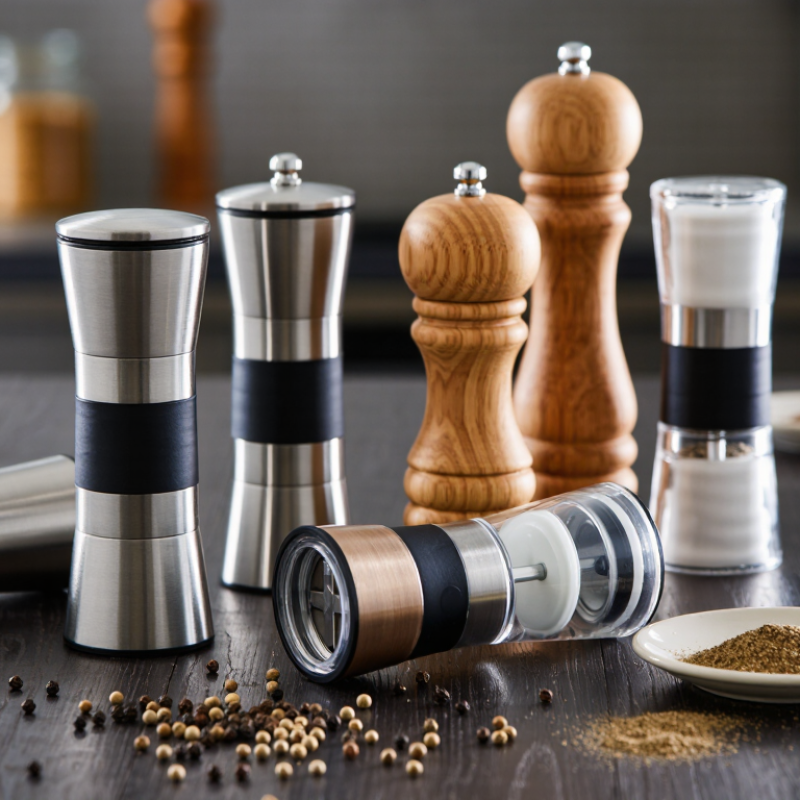
2026 Top Pepper Mill Suppliers for Global Buyers

Pepper Mill Supplier Categories and Product Types

2026 Top Pepper Mill Suppliers for Global Buyers

Pepper mill suppliers generally fall into four categories: manufacturers, OEM/ODM factories, import wholesalers, and specialist distributors. Manufacturers offer tighter control over burr geometry, shaft alignment, and food-contact materials. OEM/ODM suppliers add private-label finishes, packaging, and custom grinding settings. Import wholesalers suit buyers needing mixed cartons and faster replenishment. Specialist distributors often provide better technical support, but their minimum orders may be higher.

Product types vary by mechanism and use. Manual mills commonly use ceramic or hardened steel grinders. Ceramic resists corrosion, while steel often delivers stronger cracking performance. Electric mills offer one-hand operation and may include lighted bases or adjustable coarseness. Gravity mills are convenient, though their sensors can increase return risk. Wood, stainless steel, acrylic, and recycled composite bodies serve different price tiers. Commercial buyers should request salt, moisture, and cycle testing, not just attractive samples.

Grand View Research valued the global kitchenware market at about 71.95 billion dollars in 2023 and projected continued growth through 2030. A 2024 Technavio assessment also identified convenience and premium household products as important demand drivers. These reports cover broader categories, so pepper mill figures should be treated cautiously. That matters. Supplier claims are not proof. Buyers should compare burr life, output per turn, food-contact declarations, carton drop-test results, and spare-part availability. My practical concern is often overlooked: a smooth prototype can hide inconsistent grinding after several months. Reliability needs repeated testing, not polished photography.

Key Criteria for Evaluating Global Pepper Mill Suppliers

2026 Top Pepper Mill Suppliers for Global Buyers

Key Criteria for Evaluating Global Pepper Mill Suppliers

A reliable pepper mill supplier should prove performance, not just present attractive photographs. Request production samples and test them with whole peppercorns of different sizes. Check grinding consistency, adjustment control, refill access, and resistance to moisture. Test the mechanism repeatedly. Small details matter.

Material selection deserves close attention. Food-contact components should have clear specifications and suitable compliance documents for the destination market. Stainless steel, ceramic, and treated wood can perform differently under daily use. Ask for material reports, factory inspection records, and batch traceability. A polished surface may hide a weak internal mechanism.

Supplier capability also includes production stability. Compare minimum order quantities, lead times, packaging strength, and replacement-part support. Review whether the supplier can maintain quality across larger batches, rather than relying on one successful sample. Request documented inspection procedures and photographs from real production lines. Independent testing can add confidence, although it increases cost and time.

Communication is another practical measure. A professional supplier should explain limitations clearly and respond with precise data. Be cautious when every answer sounds perfect. Initial samples rarely reveal long-term wear. Recheck claims against current import, labeling, and food-contact requirements in each target market. I would also test packed units after shipping, because vibration and humidity can damage otherwise sound products.

2026 Top Pepper Mill Suppliers for Global Buyers - Key Criteria for Evaluating Global Pepper Mill Suppliers

Evaluation Dimension Recommended Benchmark for Global Buyers Relevant Evidence to Request Why It Matters
Food-contact material compliance Materials should comply with the food-contact rules applicable in the destination market, such as EU Regulation (EC) No 1935/2004 or relevant United States FDA requirements. Material declarations, migration-test reports, supplier declarations of compliance, and destination-market regulatory documentation. Reduces the risk of restricted substances, odor transfer, contamination, and customs or retail compliance problems.
Grinding mechanism Mechanism options should be clearly specified, such as ceramic, stainless steel, or hardened steel, together with adjustment settings and intended use. Technical drawings, material specifications, grind-size test results, corrosion-resistance information, and product samples. The mechanism determines grind consistency, service life, maintenance needs, and suitability for pepper, salt, or other spices.
Product durability The supplier should define expected operating conditions and provide repeatable tests for the body, shaft, knob, grinding mechanism, and lid. Drop-test procedures, cycle-test records, torque tests, corrosion tests, and documented corrective actions. Durability directly affects warranty costs, customer reviews, replacement rates, and long-term retail performance.
Quality-management system A documented quality system, preferably supported by a current ISO 9001 certificate or an equivalent internal quality-control process. Valid certificate, audit scope, inspection plan, incoming-material controls, final-inspection records, and nonconformity reports. Consistent processes are more reliable than sample approval alone and help control variation across production batches.
Factory and production capability The supplier should demonstrate suitable machining, molding, finishing, assembly, and packaging capacity for the buyer’s forecast volume. Factory audit, production-flow chart, equipment list, capacity statement, staffing information, and subcontractor controls. Verifies whether the supplier can scale production without compromising tolerances, finish, or delivery schedules.
Customization and tooling Custom dimensions, finishes, packaging, logos, and grind settings should be supported by approved drawings and a controlled sample process. Tooling quotation, ownership terms, engineering-change procedure, pre-production sample, and golden-sample approval record. Clear customization controls reduce disputes over appearance, dimensions, functionality, and intellectual-property ownership.
Minimum order quantity and lead time The quotation should separate sample lead time, tooling lead time, standard production lead time, and replenishment lead time. Written quotation, production schedule, capacity reservation terms, holiday calendar, and late-delivery policy. Transparent lead-time data supports inventory planning and prevents unexpected delays during seasonal demand peaks.
Packaging and shipping efficiency Packaging should protect the mechanism and surface finish while providing accurate carton dimensions, unit counts, gross weight, and net weight. Packaging specification, carton-drop test, pallet pattern, carton markings, barcode files, and shipping-carton photographs. Correct packaging information improves freight-cost estimates, warehouse planning, and damage prevention.
Sustainability and traceability Wood components should have traceable sourcing documentation when required; packaging should identify recycled content or recyclability claims accurately. Chain-of-custody documentation where applicable, material-origin records, packaging declarations, and sustainability-policy documents. Traceability supports environmental claims, retailer requirements, responsible sourcing, and regulatory reporting.
Testing and inspection control A documented inspection plan should define dimensional tolerances, appearance standards, grinding performance, assembly checks, and sampling levels. Inspection checklist, approved reference sample, measurement records, third-party inspection option, and batch-release procedure. Objective acceptance criteria make quality decisions measurable and reduce disagreements between buyer and supplier.
Commercial transparency Pricing should identify product cost, tooling, packaging, testing, delivery terms, payment terms, and any material or finish surcharges. Itemized quotation, Incoterms® 2020 rule, payment schedule, quotation validity, and price-adjustment conditions. An itemized offer allows buyers to compare total landed cost rather than headline unit price alone.
After-sales support The supplier should provide a written warranty scope, spare-part policy, complaint-response process, and corrective-action timeline. Warranty terms, replacement-part list, complaint form, response-time commitment, and examples of corrective-action reports. Effective support limits the commercial impact of defects and helps maintain customer satisfaction after launch.

Note: Compliance requirements depend on the product materials, intended use, packaging, and destination market. Buyers should confirm applicable regulations with the relevant authorities or qualified compliance professionals.

Leading 2026 Pepper Mill Suppliers by Market and Capability

In 2026, leading pepper mill suppliers will be selected by market fit, production capability, and dependable service. Global buyers need more than attractive samples. They should examine grinding performance, material consistency, packaging strength, and delivery records. Suppliers serving Europe may prioritize food-contact documentation and recyclable packaging. North American buyers often request retail-ready designs and stable replenishment. Hospitality distributors may need larger capacities and faster bulk production.

Capability matters across every market. Ceramic mechanisms suit salt and pepper sets because they resist corrosion. Hardened steel mechanisms can support frequent kitchen use when properly finished. Adjustable settings should produce noticeable differences, from coarse seasoning for grilled meat to fine powder for soups. Buyers should request production samples from several batches. One perfect sample proves little. Ask for test results, inspection photos, carton dimensions, and replacement-part policies before placing a large order.

Reliable suppliers communicate clearly about minimum order quantities, tooling charges, lead times, and quality tolerances. They should explain how they control wood moisture, coating adhesion, and mechanism alignment. These details affect cracking, uneven grinding, and customer complaints. I would also compare factory capacity with seasonal demand, especially before major holidays. A lower quotation can hide weaker inspection procedures or unstable material sourcing. No evaluation is flawless. Even experienced buyers can overlook small defects until the mills reach store shelves.

Quality Standards, Materials, and Customization Options

For global buyers, pepper mill quality starts with repeatable grinding. The ISO Survey 2022 recorded 1,265,216 valid ISO 9001 certificates worldwide. This supports supplier screening, but certification alone cannot prove a durable mill. Request batch records, salt-spray results, burr-life testing, and food-contact declarations. A practical sample should grind coarse, medium, and fine settings without slipping. Feel the adjustment ring. It should not wobble.

Material choices shape performance and appearance. Ceramic burrs resist corrosion and suit humid kitchens. Hardened stainless-steel burrs usually offer sharper grinding and stronger commercial performance. Glass bodies show fill levels, while acacia or rubberwood adds warmth but needs controlled moisture content. For coatings, ask about migration testing under applicable food-contact rules. The 2024 Grand View Research kitchen appliances report estimated the global market at about USD 241.8 billion in 2023, showing why consistency and customization matter across large purchasing programs. That figure is broad, not pepper-mill specific.

Tips: Specify burr material, grind range, body dimensions, logo method, color tolerance, packaging tests, and replacement-part availability. Ask for a golden sample before production. Also test the product after simulated shipping. Many suppliers overlook this. A beautiful prototype may still arrive with cracked glass or loose caps. Customization should improve use, not merely decoration. A small flaw in the specification can become thousands of customer complaints.

Sourcing, Pricing, Compliance, and Logistics for International Buyers

2026 Top Pepper Mill Suppliers for Global Buyers

International buyers should compare suppliers through product evidence, not catalog promises. Request samples with ceramic or stainless-steel mechanisms, adjustable grinding settings, and food-contact declarations. A supplier offering traceable materials usually reduces quality disputes. Ask for factory audit records, production capacity, and recent export references. One sample is not enough.

Pricing depends on wood, stainless steel, acrylic, mechanism design, packaging, and order volume. Typical quotations may range from a few dollars to over twenty dollars per unit. Confirm whether prices are EXW, FOB, or delivered. Include tooling, sample fees, inspection, and replacement parts. A low quote can mislead. It may exclude inner packaging or export documents.

Compliance needs careful checking. Require material specifications, migration test reports, labeling details, and documentation suited to the destination market. Claims about recycled content should be verifiable. For logistics, confirm carton dimensions, pallet stacking, lead time, and port options before signing. Salt air can affect untreated metal components during long sea transit. Use moisture-resistant cartons and protective separators. Air freight suits urgent samples, while sea freight usually lowers unit cost. One practical weakness remains: forecasts can change quickly. Buyers should review costs quarterly, especially when timber, steel, freight, or currency prices shift.

FAQS

What types of pepper mill suppliers are available?

Manufacturers control grinder geometry, shaft alignment, and food-contact materials. OEM/ODM factories support custom finishes and packaging. Import wholesalers suit mixed cartons. Specialist distributors may offer stronger technical support, but minimum orders can be higher.

Which grinding mechanism should buyers choose?

Ceramic mechanisms resist corrosion and suit salt or pepper sets. Hardened steel often provides stronger cracking performance. Test both before deciding.

Are electric or gravity mills better for convenience?

Electric mills allow one-hand operation and may include lights or adjustable settings. Gravity mills are convenient but depend on sensors. Sensor failures can increase returns.

What materials are commonly used for mill bodies?

Wood, stainless steel, acrylic, and recycled composites serve different price levels. Wood requires moisture control. Metal components need protection during humid sea transport.

How can buyers test product reliability?

Request production samples from several batches, not one polished prototype. Check output per turn, burr life, alignment, and coarseness changes. Repeat testing matters.

What documents should international buyers request?

Ask for material specifications, food-contact declarations, migration reports, and destination-market labeling details. Recycled-content claims should be verifiable. Paperwork alone is not proof.

What costs should be included in supplier quotations?

Confirm whether pricing is EXW, FOB, or delivered. Add tooling, samples, inspections, packaging, export documents, and replacement parts. Cheap quotes can hide missing costs.

How should pepper mills be packaged for shipping?

Confirm carton dimensions, pallet stacking, separators, and moisture-resistant cartons. Protective packaging reduces scratches and movement. Small defects still happen.

What supplier details should buyers compare before ordering?

Compare minimum orders, lead times, production capacity, quality tolerances, and seasonal availability. Review factory records and recent export references. No evaluation is perfect.

How often should buyers review sourcing costs?

Review costs quarterly because timber, steel, freight, and currency prices can change quickly. Forecasts may fail. Build some flexibility into purchasing plans.

Conclusion

This guide to the 2026 Pepper Mill supplier market helps global buyers understand the main supplier categories, including manufacturers, private-label producers, wholesalers, and specialized custom developers. It explains how to compare suppliers by production capacity, grinding performance, material quality, product consistency, certifications, communication, and after-sales support. Buyers will also learn how leading suppliers differ by regional strengths, technical capability, order flexibility, and experience serving international markets.

The article reviews common materials such as stainless steel, aluminum, wood, ceramic, and durable food-contact plastics, along with customization options covering size, mechanism, finish, packaging, branding, and product design. It also outlines practical considerations for sourcing, including price structure, minimum order quantities, sampling, payment terms, compliance documentation, import requirements, shipping methods, lead times, and quality inspections. With these criteria, international buyers can build a reliable supplier shortlist and select Pepper Mill products that balance performance, cost, safety, customization, and long-term supply stability.


Sienna

Sienna

Sienna is a skilled marketing professional with a deep expertise in our company’s core products and services. With a passion for innovation and detail, she plays a pivotal role in crafting insightful blog posts that not only highlight the unique features of our offerings but also provide valuable......