Choosing the right Coffee Grinder can shape every cup your business serves. It affects flavor clarity, brewing speed, waste, and customer satisfaction. A café may need a different grinder from a hotel, bakery, restaurant, or mobile coffee bar. The busiest shop might value rapid dosing, while a smaller team may prefer simple controls and easier cleaning.
Real-world experience shows that specifications alone do not tell the whole story. Burr size, grind consistency, motor strength, adjustment range, and heat control all deserve careful attention. A grinder that performs well during a quiet test may struggle during a busy breakfast service. Listen to the motor. Watch the grounds. Notice how much coffee remains inside after dosing.
Your menu should guide the decision. Espresso-focused businesses often require precise micro-adjustments and stable performance. Filter coffee stations may benefit from wider settings and dependable batch grinding. Staff comfort matters too. Complicated equipment can slow service and create inconsistent results. Keep training practical.
Budget matters.
However, the cheapest option can become expensive through repairs, wasted beans, or poor workflow. Reliable manufacturers, accessible replacement parts, warranty coverage, and local technical support can reduce operational risk. Reviews from working coffee professionals provide useful evidence, but they should not replace hands-on testing. Every business has different volumes, spaces, and expectations.
There is no perfect grinder for everyone. Even experienced operators sometimes underestimate cleaning time or noise levels. A thoughtful choice balances cup quality, durability, maintenance, and daily usability. This guide will help you compare those factors clearly before making a confident investment.
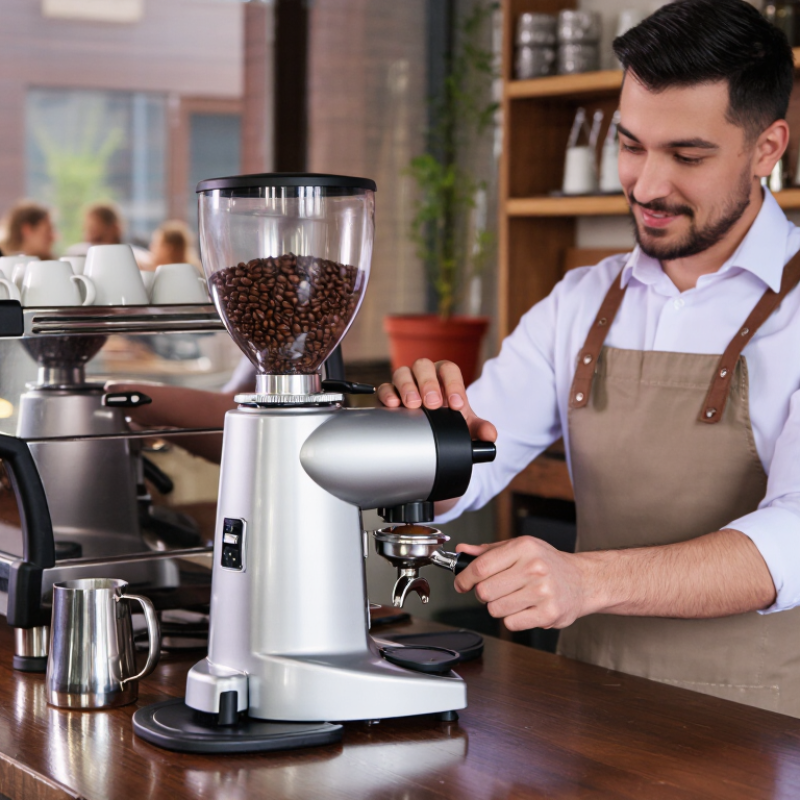
Before choosing a grinder, define exactly how your business produces coffee. The National Coffee Association’s Spring 2024 report found that 67% of American adults drank coffee the previous day. That figure shows demand, but it does not reveal your peak workload. Track cups sold during your busiest 30 minutes, not your daily average. A small café serving 40 espresso drinks quickly needs different capacity from an office brewing 80 pots slowly. Record brew methods, dose sizes, grind settings, and service times for one working week. Real numbers beat hopeful estimates.
Think about consistency, heat, retention, and cleaning time. The Specialty Coffee Association identifies particle-size distribution as an important factor in extraction control. In practice, uneven grounds can create both bitter and weak flavors in the same cup. Measure output with a scale. Check whether the grinder repeats the target dose after several orders. Also consider staff movement. A grinder that needs constant adjustment may quietly slow the queue. I have seen attractive equipment fail this test.
Tips: Build a simple production sheet. Include peak drinks per hour, grams per dose, filter changes, and cleaning minutes. Add a 20% capacity buffer for rushes and future growth. Do not assume larger is always better. Excess capacity can increase cost, noise, and wasted coffee. Review the sheet after two weeks. Your first estimate may be wrong. That is useful information.
Choosing a commercial grinder starts with the brewing methods your business actually serves. The International Coffee Organization reported global coffee consumption near 177 million 60-kilogram bags in 2023/24. That scale rewards consistency, not just speed. For espresso, choose a burr grinder with precise, small adjustments. For filter coffee, wider settings and stable dosing matter more. Blade grinders remain inexpensive, but they produce uneven particles and inconsistent extraction.
Flat burrs often deliver strong uniformity at high volumes. They can suit busy espresso stations. Conical burrs usually manage heat efficiently and may perform well in smaller shops. Neither system is automatically better.
Burr alignment, motor control, and cleaning access can matter more than shape. Stepped adjustment is simple for routine recipes. Stepless adjustment gives finer control, but staff need training. A beautiful dial will not fix poor calibration.
Grinding methods should match service pressure. Electric grinding supports speed, while manual grinding may suit low-volume counters or tasting sessions. The National Coffee Association’s 2024 report found that 67% of American adults drank coffee in the past day, showing how routine demand can become operational pressure.
In practice, I test retention by weighing 18 grams in and out, then inspect the chute for residue. I would not pretend one trial proves durability. Track dose variation, burr wear, noise, and cleaning time for several weeks. Small differences become expensive during a crowded morning.
Choosing a commercial coffee grinder starts with your busiest service period, not its advertised motor power. Track drinks sold during a fifteen-minute rush. Then choose a hopper and workflow that prevent constant refilling. A café serving 180 espresso drinks daily may need more capacity than a small bakery, even if both use the same beans. Speed matters when a queue forms, but excessive speed can heat the grounds and affect flavor. Listen for uneven dosing and watch how long the grinder needs between orders. I once prioritized speed and underestimated cleaning time. That mistake slowed the whole bar.
Consistency deserves a practical test. Grind the same dose ten times, weigh each output, and compare the results. Check the particles visually, then brew several shots using identical settings. If extraction times jump widely, the grinder may be poorly aligned or difficult to adjust. Grind-size control should support small, repeatable changes. Espresso often needs fine adjustments, while filter coffee requires a wider range and clearer scale. A stepped dial can help staff return to a proven setting, but a stepless design may offer finer control. Train staff to record dose, grind position, and brew time beside the machine. Keep notes. They reveal patterns. Recheck performance after cleaning, because burr wear and residue can change results. I would also test noise during service; quiet operation is pleasant, but it does not prove consistency.
| Business Grinder Profile | Recommended Daily Output | Hopper Capacity | Typical Grinding Speed | Consistency Performance | Grind-Size Control | Suitable Business Use | Key Evaluation Point |
|---|---|---|---|---|---|---|---|
| Light-Duty Commercial Grinder | Up to 5 kg per day | 0.5–1.0 kg | Approximately 1.5–3.0 g/s | Good for low-volume espresso and filter brewing when the grinder is correctly calibrated | Usually stepless or fine stepped adjustment; supports espresso, moka pot, and filter ranges | Small cafés, bakeries, offices, and restaurants with limited coffee demand | Prioritize compact size, easy adjustment, low retention, and simple cleaning |
| Standard Café Espresso Grinder | 5–15 kg per day | 1.0–1.5 kg | Approximately 2.5–5.0 g/s | High repeatability when burrs are sharp and dosing is properly calibrated | Stepless micrometric adjustment is preferred for precise espresso dialing-in | Independent cafés and restaurants serving a steady flow of espresso drinks | Balance speed with temperature control and dose-to-dose repeatability |
| High-Volume Espresso Grinder | 15–30 kg per day | 1.5–2.0 kg | Approximately 3.5–7.0 g/s | Very good consistency when equipped with effective cooling and durable commercial burrs | Precise stepless adjustment with programmable single- and double-dose settings | Busy cafés, hotels, coffee bars, and locations with continuous drink orders | Check thermal stability, motor duty cycle, recovery time, and service accessibility |
| High-Throughput Bulk Grinder | 30 kg or more per day | 2.0–3.0 kg or larger | Approximately 6.0–12.0 g/s | Designed for consistent large batches rather than frequent small espresso adjustments | Usually stepped or calibrated settings for filter, batch brew, and coarse applications | Roasteries, wholesale operations, supermarkets, and large-volume batch brewing | Capacity and continuous-duty performance are more important than a compact footprint |
| Multi-Purpose Café Grinder | 5–20 kg per day | 0.8–1.5 kg | Approximately 2.0–5.0 g/s | Good across multiple brew methods, although frequent setting changes may affect workflow | Wide adjustment range from fine espresso to coarse French press or cold brew | Cafés offering espresso, pour-over, French press, and other brew methods | Look for clear adjustment markings, low retention, and easy repeatability between settings |
| Dedicated Filter and Batch-Brew Grinder | 10–40 kg per day | 1.5–3.0 kg | Approximately 5.0–15.0 g/s | Strong particle-size uniformity at medium and coarse settings improves extraction consistency | Broad stepped range with repeatable settings for batch brew and manual filter recipes | Offices, hotels, catering businesses, and specialty cafés focused on brewed coffee | Evaluate particle distribution, batch repeatability, and compatibility with brew volume |
| Decaffeinated or Single-Origin Support Grinder | Up to 10 kg per day | 0.3–1.0 kg | Approximately 1.5–4.0 g/s | Good when used for occasional or separate coffees and regularly purged between products | Fine adjustment range suitable for switching between espresso recipes | Cafés that serve decaffeinated coffee, rotating single origins, or specialty selections | Low retention and easy access to the grind chamber help reduce flavor carryover |
A commercial grinder must survive repeated use, heat, and hurried staff handling. Inspect the housing, adjustment mechanism, hopper, and grinding chamber before purchase. Metal components often tolerate heavy workloads better than fragile plastics, but construction alone does not guarantee durability. Ask for service records, expected component life, and replacement-part availability. A five-minute demonstration can reveal unusual vibration or unstable settings.
Maintenance affects both coffee quality and labor costs. Choose a grinder with accessible burrs, removable panels, and clear cleaning instructions. Daily brushing may take only a few minutes, while neglected coffee oils can create stale flavors and block the chute. Safety matters just as much. Look for secure lids, overload protection, grounded electrical design, and guards around moving parts. Confirm compliance with applicable local safety requirements. I once underestimated cleaning time during busy service. That mistake changed the cost calculation.
Tips: Measure noise during operation, not in a quiet showroom. Track electricity use, cleaning minutes, replacement parts, and downtime for one month. Compare those figures with expected daily orders. A cheaper grinder can become expensive when staff wait for repairs. Also, test the adjustment collar with warm hands and gloves. Small controls may feel convenient at first, yet become frustrating during a crowded morning. Leave room around the grinder for cleaning and ventilation. Apparently obvious, but often missed.
Choosing a grinder starts with your brewing equipment, not its advertised speed. Your grinder should fit the brewer, workflow, and cash you can safely spend. According to the NCA’s Spring 2024 National Coffee Data Trends report, 67% of U.S. adults drank coffee the previous day. USDA’s December 2024 Coffee: World Markets and Trade forecast 174.9 million 60-kilogram bags for 2024/25. More cups demand stable output, but volume alone does not justify premium controls.
For espresso, prioritize fine adjustment, low retention, and repeatable dosing. A café serving several hundred shots daily also needs a motor rated for sustained duty. For batch brewing, favor consistent coarse particles, a timer, and an easy-to-clean chute. Pour-over service can accept a smaller commercial grinder if staff can adjust quickly. The Specialty Coffee Association links grind size, dose, and extraction in its brewing standards. That relationship matters more than a decorative display.
Budget in stages: grinder, spare burrs, cleaning tools, and staff training. A cheaper unit may become expensive through retention, re-dosing, and downtime. Yet the most expensive grinder is not automatically the wisest purchase. I would test it beside your actual brewer for one busy week. Track shot time, waste, noise, heat, and queue delays. If the data is missing, your decision is partly guesswork.
Match grinder features to your budget and brewing equipment by comparing typical purchase cost with suitable daily coffee output. Higher-capacity grinders generally offer larger burrs, stronger motors, better heat control, and greater consistency for busy operations.
How to read the chart: Choose a grinder tier that supports your expected daily volume without exceeding your equipment budget. For espresso-focused businesses, prioritize grind adjustment precision and heat management. For batch brewing, prioritize throughput, dosing consistency, and compatibility with larger brew baskets.
Measure drinks sold during the busiest fifteen-minute period. Choose a hopper that avoids constant refilling. A café serving 180 drinks daily needs more capacity than a small bakery. Estimates can be wrong without real sales records.
Not always. Excessive speed can heat grounds and affect flavor. Watch queue delays, recovery time, and uneven dosing during service. I once valued speed too highly and ignored cleaning time.
Grind the same dose ten times and weigh every output. Compare particles visually, then brew repeated shots with identical settings. Large extraction-time changes suggest alignment or adjustment problems.
Espresso benefits from fine, repeatable adjustments. Filter coffee needs a broader range and a clear scale. Stepped controls help staff return to known settings. Stepless controls may offer finer tuning but slow busy workflows.
Look for accessible burrs, removable panels, and clear cleaning instructions. Brush daily and remove oily residue from the chute. Leave space around the grinder for cleaning and ventilation. Easy maintenance protects flavor and labor time.
Inspect the housing, adjustment collar, hopper, and grinding chamber. Watch for vibration or unstable settings during a short demonstration. Confirm secure lids, overload protection, grounded electrical design, and guards around moving parts. Verify local safety requirements too.
Track electricity, cleaning minutes, replacement parts, waste, and repair downtime for one month. Compare those figures with daily orders. A cheaper grinder may cost more when staff wait for repairs. The cheapest option can mislead.
Test the grinder beside the actual brewer for one busy week. Record shot time, retention, heat, noise, waste, and queue delays. Budget for spare burrs, cleaning tools, and staff training. Missing data means some guesswork remains.
Choosing the right Coffee Grinder begins with understanding your business’s daily production needs, including expected volume, service speed, and the brewing methods you use. Different grinder types, burr systems, and grinding methods can affect flavor, texture, consistency, and workflow. Consider whether your operation needs precise control for espresso, flexible settings for multiple brewing styles, or a reliable solution for steady high-volume service.
It is also important to evaluate capacity, grinding speed, dose consistency, and grind-size adjustment. A suitable grinder should be durable, easy to clean, safe to operate, and affordable to maintain over time. Compare energy use, replacement parts, maintenance requirements, and overall operating costs before making a decision. Finally, match the grinder’s features and performance to your budget and existing brewing equipment. The best choice is not always the most advanced model, but the one that supports your workflow, quality standards, and long-term business goals.