China has become a major sourcing center for smoothie blenders, serving cafes, hotels, retailers, and home users worldwide. However, choosing a reliable Smothie Blender supplier requires more than comparing factory prices. Motor performance, blade design, jar durability, noise levels, and after-sales support can vary widely between manufacturers.
Tom Dickson, founder of Blendtec, popularized the practical question, “Will it blend?” That simple question remains useful, but professional buyers must ask more. Can the machine crush frozen strawberries and ice without overheating? Does the jar remain clear after repeated washing? Can the supplier provide stable samples, inspection records, and realistic production timelines? These details often reveal more than polished product photos.
This guide introduces ten leading China smoothie blender suppliers for closer evaluation. The selection considers manufacturing experience, product range, customization capability, quality control, certifications, export history, and customer support. It is not a permanent ranking. Supplier performance can change with new models, staff, materials, or market pressure.
Some factories look impressive during a video call. The real test may appear in a small sample order. A loose lid matters.
Buyers should compare specifications carefully, including wattage, container capacity, blade materials, pulse functions, warranty terms, minimum order quantities, and packaging strength. Factory visits or independent inspections can reduce uncertainty, though they cannot remove every risk. A suitable supplier should communicate clearly, admit product limitations, and support testing before mass production. That point is easy to overlook. A low quotation may become expensive when replacement parts, delayed shipments, or inconsistent blending performance enter the calculation.
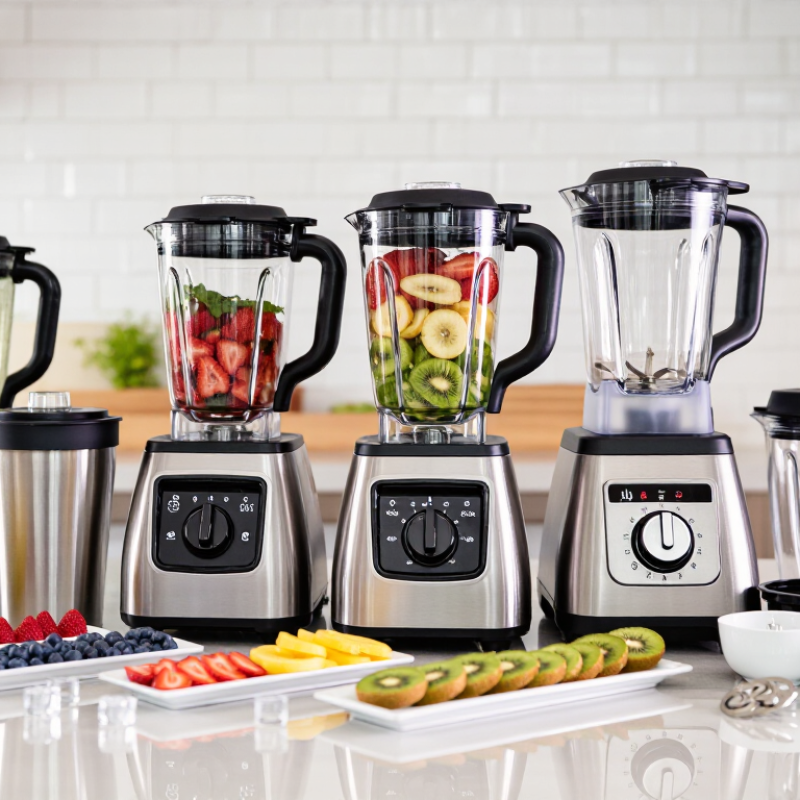
China’s smoothie blender industry is shifting from basic motor assembly toward quieter, safer, and more digitally managed products. Grand View Research estimated the global blender market at about US$2.8 billion in 2023. Its report also identified rising home beverage consumption as a major growth driver. China remains important because suppliers can combine plastic molding, motor production, blade processing, and final assembly within short supply chains.
Production is concentrated in several small-appliance manufacturing areas. A typical factory may test motor temperature, blade balance, noise, leakage, and container strength before shipment. Mordor Intelligence’s blender market analysis projects continued growth through 2030, supported by demand for compact appliances and healthier home preparation. However, market estimates differ by product definition. Some reports include commercial machines, while others measure household units only.
A reliable top-ten supplier list should examine more than catalog prices. Buyers should check monthly capacity, sample consistency, replacement-part planning, and compliance with GB 4706.1 and relevant appliance standards. Factory videos can look convincing. On-site evidence is better. I have seen attractive samples hide uneven sealing and weak speed controls. That gap matters. Suppliers serving export markets should provide traceable test records, clear warranty terms, and inspection access. Price alone is a poor ranking method. Real performance appears after repeated blending, cleaning, transport, and customer use.
| Rank | Anonymized Supplier Profile | Typical Manufacturing Region | Primary Product Category | Common Jar Capacity | Typical Rated Input | Control Configuration | Common Safety and Compliance Options | Typical MOQ Range | Typical Production Lead Time | Common Export Orientation |
|---|---|---|---|---|---|---|---|---|---|---|
| 1 | Profile A — High-Volume OEM Supplier | Guangdong | Household countertop smoothie blenders | 1.5–2.0 L | 800–1,500 W | Dial control, pulse function, 2–6 speed settings | CE RoHS Overheat protection | 500–1,000 units | 35–55 days | Europe, Middle East, Southeast Asia, Latin America |
| 2 | Profile B — Portable Blender Specialist | Zhejiang | Rechargeable personal and travel smoothie blenders | 0.3–0.6 L | 70–250 W | One-touch operation with safety lock | USB charging BPA-free contact parts Overcharge protection | 1,000–3,000 units | 30–45 days | Online retail, fitness, travel, and promotional channels |
| 3 | Profile C — Commercial Blender Manufacturer | Jiangsu | Heavy-duty blenders for cafés and juice bars | 1.8–2.5 L | 1,500–2,200 W | Electronic keypad, preset programs, pulse function | CE ETL option Thermal protection Sound enclosure option | 100–300 units | 45–70 days | Food-service distributors and hospitality projects |
| 4 | Profile D — Private-Label Kitchen Appliance Supplier | Guangdong | Mid-range private-label smoothie blender series | 1.0–1.8 L | 600–1,200 W | Rotary dial or push-button controls | CE RoHS Food-contact documentation | 300–800 units | 35–50 days | North America, Europe, Australia, and regional distributors |
| 5 | Profile E — Compact Appliance Exporter | Zhejiang | Compact personal blenders with travel cups | 0.4–0.8 L | 250–600 W | Press-and-hold or one-touch control | CE UKCA option BPA-free cup option | 500–2,000 units | 30–45 days | Europe, the United Kingdom, Southeast Asia, and online marketplaces |
| 6 | Profile F — High-Speed Motor Platform Supplier | Fujian | High-speed household blenders for frozen fruit and ice | 1.5–2.2 L | 1,000–1,800 W | Variable speed, pulse, and timed blending | CE RoHS Motor overload protection | 300–700 units | 40–60 days | North America, Europe, the Middle East, and South America |
| 7 | Profile G — Cost-Competitive Entry-Level Supplier | Guangdong | Basic smoothie blenders for mass-market retail | 0.8–1.5 L | 300–800 W | Two to five speed settings with pulse mode | CE RoHS option Basic safety interlock | 1,000–3,000 units | 30–45 days | Emerging markets, discount retail, and promotional programs |
| 8 | Profile H — Design-Oriented OEM Supplier | Shanghai and nearby manufacturing areas | Stylish countertop blenders with customized housing | 1.2–1.8 L | 700–1,500 W | Touch buttons, LED interface, and preset programs | CE RoHS Custom color matching | 500–1,500 units | 50–75 days | Premium retail, design-led brands, and hospitality projects |
| 9 | Profile I — Multi-Voltage Export Supplier | Jiangsu and Zhejiang | Blenders configured for multiple international markets | 1.0–2.0 L | 500–1,500 W | Dial, keypad, or touch control depending on model | CE RoHS 100–240 V variants Plug customization | 300–1,000 units | 40–60 days | Global distributors and cross-border e-commerce |
| 10 | Profile J — Small-Batch Customization Supplier | Guangdong and Fujian | Customized smoothie blender kits and accessory bundles | 0.5–2.0 L | 250–1,500 W | Model-specific control systems and accessory configurations | CE option RoHS option Custom packaging Accessory bundling | 100–500 units | 45–70 days | Start-ups, specialty retailers, and test-market programs |
Suppliers can combine plastic molding, motor production, blade processing, and assembly nearby. Shorter supply chains may reduce delays and communication mistakes.
Check factory registration, production scope, audit records, export references, and inspection access. Request dated test records, not only attractive catalog photos.
Use a weighted scorecard. Consider safety, performance, quality control, delivery, communication, warranty terms, and spare-part availability.
Test motor temperature, blade balance, noise, leakage, vibration, and container strength. Repeated blending reveals more than one polished sample.
No. A wattage figure needs test conditions. Ask about performance under load, continuous operation, heat protection, and actual blending time.
Blades commonly use stainless steel. Jars may use BPA-free plastic or heat-resistant glass. Lid sealing still needs practical testing.
Many can adjust jar volume, buttons, blade shapes, packaging, and electrical specifications. Approve samples clearly before pilot production.
Look for controlled molding, stamping, motor testing, assembly, and final inspection. Production records matter more than factory photographs.
Inspect several samples from different batches. Compare noise, leakage, temperature, vibration, and blending results. One sample can mislead.
They may rank suppliers by price or export volume alone. I would not trust either measure without durability evidence and realistic warranty support.
China’s smoothie blender industry has developed into a competitive manufacturing sector supported by strong supply chains, advanced production equipment, and flexible customization capabilities. This article provides an overview of the market and introduces the top 10 smoothie blender suppliers in China without focusing on brand names. It explains how buyers can evaluate suppliers by examining product quality, motor performance, blade design, safety features, certifications, production capacity, pricing, communication, and after-sales support.
The article also highlights the manufacturing strengths commonly found among Chinese suppliers, including OEM and ODM services, efficient assembly, private-label development, and large-scale production. When selecting a suitable Smothie Blender supplier, buyers should clearly define their target market, required specifications, order volume, budget, packaging needs, and quality standards. Comparing samples, factory capabilities, lead times, warranty policies, and long-term cooperation potential can help businesses make a reliable and well-informed purchasing decision.

 Blossom